 F216


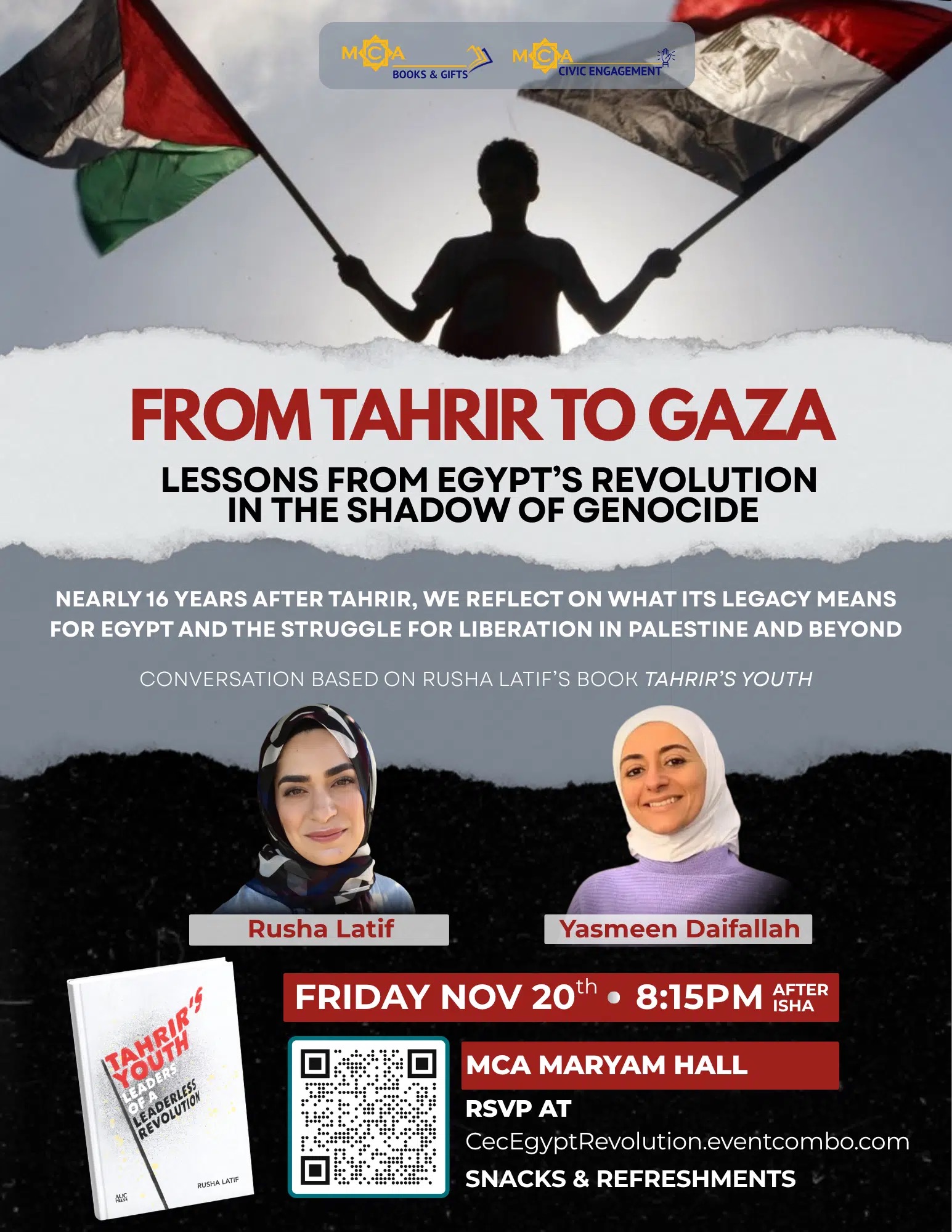
What can we learn from the young people who took to the streets and helped spark Egypt’s 2011 Revolution? Nearly sixteen years later, we invite you to join us for a conversation about the experiences, aspirations, and struggles of the generation that ignited Tahrir and the questions their uprising continues to raise for us today.
Drawing on Rusha Latif’s book Tahrir’s Youth: Leaders of a Leaderless Revolution, based on her firsthand research during the revolution, we will reflect on the legacy of Tahrir amid the ongoing genocide in Gaza and the widening conflict across the Middle East. In a moment shaped by the struggle for Palestinian liberation and renewed waves of popular resistance around the world, what can Egypt’s revolution teach us about movement-building, political imagination, and the possibilities of collective struggle? And how might its lessons speak to the challenges facing the Ummah today?
About the Speakers
Rusha Latif is an Egyptian-American researcher and writer based in the San Francisco Bay Area. Her work focuses on social movements and revolutions, particularly in the Middle East. Her book, Tahrir’s Youth: Leaders of a Leaderless Revolution (2022), draws on ethnographic fieldwork in Cairo during the 2011 uprising to examine activist agency in the absence of formal leadership.
Yasmeen Daifallah is Associate Professor of Politics at UC Santa Cruz, specializing in Arab and Islamic political thought, postcolonial theory, and Middle East politics. She earned her Ph.D. from UC Berkeley and has taught at UMass-Amherst and USC.
{{eventInfo.SpeakerLabel}}
{{ key == 'null' ? '' : key}}
Frequently Asked Questions


 {{ticket.TicketName}}

 {{member.BuyerName}}